
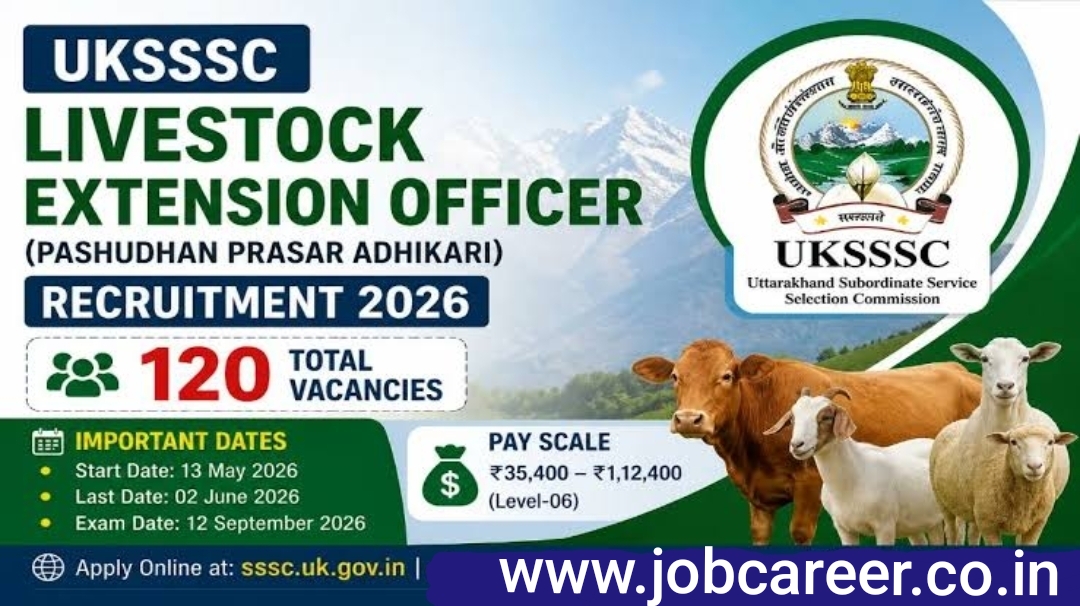
Commission Name | Uttarakhand Subordinate Services Selection Commission (UKSSSC), Dehradun |
Advertisement No. | 76/U0A0S0C0A0/2026 dated 08/05/2026 |
Post Name | Pashudhan Prasar Adhikari (Livestock Extension Officer), Group-C |
Post Code | 646/343/76/2026 |
Department | Animal Husbandry Department (पशुपालन विभाग), Uttarakhand |
Post Type | Non-Gazetted / Temporary / Contributory Pensionable (अराजपत्रित/अस्थायी/अंशदायी पेंशनयुक्त) |
Total Vacancies | 120 (108 Direct Recruitment + 12 Departmental Employees) |
Pay Scale | Rs. 35,400–1,12,400/- (Level-06) |
Application Mode | Online only (via www.sssc.uk.gov.in) |
Selection Mode | Objective Type Written Examination (MCQ) – 100 Marks, 2 Hours |
Mandatory Requirement | Uttarakhand Domicile / Original Resident certificate; Employment Office registration in Uttarakhand |
Official Website |
UKSSSC Livestock Extension Officer Recruitment 2026 Important Dates
Event | Date |
|---|---|
Date of Advertisement | 08 May 2026 |
Opening of Online Application Portal | 13 May 2026 |
Last Date for Online Application Submission | 02 June 2026 |
Correction Window (Online Application) | 05 June 2026 to 07 June 2026 |
Age Calculated As On (Cut-off Date) | 01 July 2026 |
Written Examination Date (Tentative) | 12 July 2026 (subject to change) |
Note: The examination date of 12 July 2026 is tentative. The final confirmed date will be announced separately on the UKSSSC website, in daily newspapers (press notice), and via SMS/Email to the mobile number and email ID provided in the online application.
UKSSSC Livestock Extension Officer Recruitment 2026 – Vacancy Details
A total of 120 vacancies have been announced for the post of Pashudhan Prasar Adhikari (Group-C) under the Animal Husbandry Department, Uttarakhand. These are distributed across SC, ST, OBC, EWS and Unreserved categories with horizontal reservations for Uttarakhand women (30%), Ex-Servicemen (05%), Freedom Fighter dependants (02%), Persons with Disabilities (04%), Orphan children (05%), Skilled sportspersons (04%), and Uttarakhand State Agitation activists (10%).
(i) Post: Pashudhan Prasar Adhikari – Total Posts: 120
Sl. No. | Post / Department | Reservation Category | Vacancies |
|---|---|---|---|
1 | Livestock Extension Officer (Animal Husbandry Dept.) – Direct Recruitment | SC | 21 |
ST | 04 | ||
OBC | 15 | ||
EWS | 10 | ||
UR | 58 | ||
Total | 108 | ||
2 | Livestock Extension Officer (Animal Husbandry Dept.) – For Departmental Employees only | SC | 03 |
ST | — | ||
OBC | 01 | ||
EWS | — | ||
UR | 08 | ||
Grand Total | 120 | ||
PwD (Divyang) Sub-Category – 04 Posts (out of 120)
Sub-Category | Code | Posts |
|---|---|---|
Hearing Handicapped / Physical Disability | HH/PD-01 | 01 |
Dwarfism | DW-01 | 01 |
Acid Attack Victim / Visually Impaired | AAV/AV-01 | 01 |
Leprosy Cured / Physically and Blind | LV/PB-01 | 01 |
Total PwD | 04 | |
Reservation Abbreviations: SC = Scheduled Caste (अ0जा0) | ST = Scheduled Tribe (अ0ज0जा0) | OBC = Other Backward Class (अ0पि0व0) | EWS = Economically Weaker Section (आ0क0व0) | UR = Unreserved (अना0)
UKSSSC Livestock Extension Officer Recruitment 2026 – Eligibility Criteria
Candidates must fulfill all eligibility conditions as on the closing date of online application (02-06-2026). The application is open to candidates outside the Uttarakhand Public Service Commission's purview. Candidates must be registered at an Employment Office in Uttarakhand or hold a valid Permanent/Original Resident Certificate of Uttarakhand.
Qualification
Category of Applicant | Required Qualification |
|---|---|
(i) For Direct Recruitment (सीधी भर्ती) | Bachelor's Degree in any one of the following: Biology (जीव विज्ञान) / Agriculture (कृषि) / Animal Husbandry (पशुपालन) — from any university established by law in India. |
(ii) For Departmental Employees only (विभागीय कार्मिकों हेतु) | Departmental employees who have completed 5 years of continuous service from the date of recruitment AND have passed Intermediate (10+2) with Biology or Agriculture from Uttarakhand Board of Secondary Education, Uttarakhand Board of University Education, or UP Board of Secondary Education, or any equivalent exam recognised by the Government. |
Mandatory Domicile Requirement | Permanent/Original Resident Certificate of Uttarakhand; AND Employment Office registration in Uttarakhand (mandatory for all candidates applying under Group-C direct recruitment outside UKPSC purview) |
Pre-Appointment Training Note: Selected candidates for Livestock Extension Officer will undergo 06 months training at the Departmental Training Centre and 06 months training at Departmental Veterinary Hospitals under the supervision of Veterinary Officers before being appointed to vacancies. During training, no salary, honorarium or allowances are payable.
Desirable / Additional Qualifications (Bonus Marks)
Qualification / Achievement | Bonus Marks |
|---|---|
NCC "B" Certificate | As per rules |
NSS Certificate | As per rules |
Continuous 15 years active service in Remount Veterinary Corps as Veterinary Dresser Grade-1 and Grade-2 | As per rules |
UKSSSC Livestock Extension Officer Recruitment 2026 – Age Limit
The decisive date (cut-off) for age calculation is 01 July 2026. Candidates must be minimum 21 years and not more than 42 years as on this date — i.e., born not after 01 July 2005 and not before 02 July 1984.
Category | Age Limit |
|---|---|
All Categories – Minimum Age | 21 years (as on 01-07-2026) |
General/UR – Maximum Age | 42 years (as on 01-07-2026) |
SC / ST / OBC of Uttarakhand | 5 years relaxation (max 47 years) — as per Govt. Order (Shasknadesh) No. 1399 dated 21.05.2005 |
Persons with Disabilities (Divyang) – Uttarakhand | 10 years relaxation (max 52 years) for Group-C posts — as per Shasknadesh No. 1244 dated 21.05.2005 |
Freedom Fighter Dependants – Uttarakhand | 5 years relaxation — as per Shasknadesh No. 1244 dated 21.05.2005 |
Ex-Servicemen (Uttarakhand) | Actual age minus total defence service period; resultant age must not exceed prescribed upper age limit by more than 3 years — as per Notification No. 6/1/72 Karmik-2 dated 25.04.1977 |
UKSSSC Livestock Extension Officer Recruitment 2026 – Application Fee
Sl. No. | Category | Examination Fee (Rs.) |
|---|---|---|
01 | Unreserved (UR) / Uttarakhand OBC | Rs. 300/- |
02 | Uttarakhand SC / Uttarakhand ST / EWS (Economically Weaker Section) | Rs. 150/- |
03 | Uttarakhand Divyang (Persons with Disabilities) | Rs. 150/- |
04 | Orphan (Anath) | Rs. 00/- (Nil) |
Payment mode: Credit Card / Debit Card / Net Banking / UPI only. Bank drafts and cheques are not accepted. Fee once paid is non-refundable. Application is considered complete only when fee reaches the Commission's account within the deadline.
UKSSSC Livestock Extension Officer Recruitment 2026 – Selection Process
The selection process consists of an Objective Type (MCQ) Written Examination of 100 marks and 2 hours duration. The questions will be related to the qualification prescribed for the post. Document verification is mandatory after the written examination result. The final selection list will be published on the Commission's website.
Written Examination Structure
Subject | Type | Total Questions | Maximum Marks | Duration |
|---|---|---|---|---|
Biology, Agriculture and Animal Husbandry (जीव विज्ञान, कृषि एवं पशुपालन) | Objective MCQ (OMR/CBT) | 100 | 100 | 2 Hours |
Exam Mode: The Commission may conduct the examination in Offline (OMR-based) or Online (Computer Based Test / CBT) mode depending on the number of applicants.
OMR-based Exam Rules: OMR answer sheets are in triplicate. Candidates must mandatorily submit the original and second copy to the invigilator after the exam; the third copy may be retained. Use of whitener or scratching on OMR is strictly prohibited and will attract negative marking. Candidates must not write incorrect roll numbers or booklet series codes on the OMR sheet, else their candidature will be cancelled automatically.
Qualifying Marks
Category | Minimum Qualifying Marks |
|---|---|
Unreserved (UR) / OBC / EWS | 45% (minimum) |
SC / ST | 35% (minimum) |
Negative Marking: 1/4th (¼) marks will be deducted for each wrong answer. No marks will be deducted for unanswered questions. If a candidate marks more than one answer for a question, it will be treated as wrong and ¼ marks will be deducted.
Tie-Breaking Rules
1st Tie-Break | Higher age (older candidate preferred — senior in age gets priority) |
2nd Tie-Break | Alphabetical order of names (in English alphabet) |
The seniority list will be prepared based on written exam marks combined with applicable horizontal reservation and vertical reservation norms as per Uttarakhand Govt. service rules.
Document Verification (अभिलेख सन्निरीक्षा): Document verification is a mandatory stage after written exam results. All reservation/educational/experience/desirable qualification claims must be supported by valid certificates as per service rules. Candidates absent during document verification will have their candidature cancelled. All information regarding document verification will be communicated via the UKSSSC website only.
UKSSSC Livestock Extension Officer Recruitment 2026 – Exam Syllabus
Written Examination – One Paper: Biology, Agriculture and Animal Husbandry (100 Marks, 100 Questions, 2 Hours)
Note: Part A is compulsory for all candidates. Part B (Biology – Botany and Zoology) and Part C (Agriculture and Animal Husbandry) are optional; candidates must choose any one of Part B or C.
Part A – Compulsory for All (30 Marks)
Topic | Key Sub-Topics |
|---|---|
Cell Biology | Protoplasm, Cell Theory, Prokaryotic & Eukaryotic cells, Plasma membrane, Cytoplasm, Cytoskeleton, Centrioles, Endoplasmic Reticulum, Golgi Complex, Mitochondria, Lysosomes, Plastids, Ribosomes, Nucleus & Nucleolus, Chromosomes (structure, size, shape), Cell division |
Chemical Constituents of Living Cells | Structure and classification of Proteins, Carbohydrates and Lipids |
Taxonomy | Concept of species, Nomenclature, Linnaean Hierarchy, Five Kingdom Classification, Monera, Protista and Fungi — salient features; Lichens; Viruses and Viroids; Angiosperm families: Brassicaceae, Fabaceae, Cucurbitaceae, Malvaceae, Solanaceae, Poaceae |
Morphology and Anatomy of Flowering Plants | Root, stem, leaf, inflorescence, flower, fruit and seed (Dicots and Monocots) |
Plant Physiology | Water and mineral absorption, Transpiration, Carbon assimilation & Photosynthesis, Respiration, Electron Transfer System, Translocation, Plant growth regulators |
Sexual Reproduction in Flowering Plants | Male and female gametophyte development, Pollination, Fertilization (double fertilization), Endosperm and embryo development, Seed and fruit formation, Seed dispersal, Apomixis, Parthenocarpy, Polyembryony |
Pollution (Types and Control) | Pollution-associated health hazards, Eutrophication, Biomagnification, Ozone Layer depletion, Green House Effect, Acid Rain, Green Revolution, Nitrogen Cycle, Apiculture, Sericulture, Crop pests management, Microbes and Human welfare |
Part B – Biology (Botany and Zoology) – 70 Marks [OPTIONAL – any one of B or C]
Unit | Key Topics |
|---|---|
Unit-I | Origin of life and evolution (Evolutionary theories, Evidence, Recapitulation, Lamarckism, Darwin, Weismann, Modern synthetic theory, De Vries, Gene flow, Hardy-Weinberg); Adaptations (Hydrophytes, Xerophytes, Sciophytes, Heliophytes; Terrestrial, Cursorial, Scansorial, Volant, Aquatic, Fossorial animals); Adaptive radiation; Fossilization; Human evolution |
Unit-II | Cytology (Light & Phase Contrast Microscopy, TEM, SEM; Plasma Membrane; Cytoplasm; Cytoskeleton; Centrioles; Endoplasmic Reticulum; Golgi; Mitochondria; Lysosomes; Plastids; Ribosomes; Nucleus; Nucleosome model; Eukaryotic chromosome; Polytene & Lampbrush chromosomes; Cell division); Chemical constituents; Genetic material (DNA, RNA); Genetics (Mendel's laws, Back/Test cross, Incomplete dominance, Co-dominance, Multiple alleles, Sex determination); Human Genetics (Haemophilia, colour blindness, Down's syndrome, Turner's, Klinefelter's, Thalassemia); Linkage; Crossing over; Mutations; Enzymes; Plant and animal tissue systems |
Unit-III | Taxonomy (species concept, Five kingdom classification, Monera, Protista, Fungi, Lichens, Viruses, Viroids, Prions; Fungi, Bacteria, Algae, Bryophytes, Pteridophytes, Gymnosperms — general characteristics, habitat, ecology, economics importance) |
Unit-IV | Angiosperms — classification types; Families (Ranunculaceae, Malvaceae, Brassicaceae, Fabaceae, Meliaceae, Apiaceae, Rosaceae, Rutaceae, Lamiaceae, Solanaceae, Asteraceae, Euphorbiaceae, Liliaceae, Poaceae); Pollination; Physiology (Water transport, Transpiration, Guttation, Mineral Nutrition); Photosynthesis; Respiration; Plant growth regulators |
Unit-V | Non-Chordata — Protozoa (Amoeba, Euglena, Paramecium; Entamoeba, Plasmodium, Leishmania, Trypanosoma); Metazoa — Porifera, Coelenterata, Helminthes (Taenia, Ascaris, Schistosoma, Wuchereria); Annelida; Arthropoda (Palaemon, Peripatus, Limulus; Anopheles, Culex, Aedes, Xenopsylla, Phlebotomus); Mollusca; Echinodermata |
Unit-VI | Chordata — Hemichordata, Urochordata, Cephalochordata, Cyclostomata, Pisces, Dipnoi, Amphibia, Reptilia (Chelonia, Ophidia, Crocodilia), Aves, Mammalia (Prototheria, Metatheria, Eutheria) |
Unit-VII | Metabolism (Carbohydrates, Proteins, Lipids); Skeletal System; Digestive System; Vertebrate Respiration; Circulatory System (Open & Closed, ECG, cardiovascular disorders); Excretion (ammonotelism, ureotelism, uricotelism; Kidney, Dialysis); Endocrine System (Glands, Hormones, Pheromones); Nervous System; Reproductive System |
Unit-VIII | Embryology; Animal Behaviour (Taxis, Kinesis, Instinct, Learning, Imprinting, Biological rhythms, Echolocation); Economics Botany (Plants in Human Welfare, Forests, Fruits, Cereals, Spices); Economic Zoology (Animal Husbandry — cattle breeds, AI, Poultry, Pisciculture, Sericulture, Apiculture, Integrated Pest Management) |
Unit-IX | Biogeochemical cycles; Ecosystem (Types, Trophic levels, Energy flow, Food web, Ecological pyramids, Plant succession); Population Estimation; Biodiversity (In situ & ex situ conservation, Hotspots, Ramsar sites, CITES, IUCN, Protected Areas, Tiger Reserves); Pollution |
Unit-X | Biotechnology (Nucleic acids, Genome, Recombinant DNA, Blotting, Cloning, PCR, Electrophoresis, DNA fingerprinting); Plant tissue culture (Totipotency, Callus culture); Plant breeding (Hybridization, Hybrid vigour); Biostatistics (Sampling, Central tendency, Dispersion, Standard deviation) |
Part C – Agriculture and Animal Husbandry – 70 Marks [OPTIONAL – any one of B or C]
Unit | Key Topics |
|---|---|
Unit-I | Importance of agriculture in national & Uttarakhand state economy; Classification of field crops; Crop production principles; Cultivation of common crops — Cereals: paddy, maize, wheat, barley, oat, sorghum, pearl millet, finger millet; Oilseed Crops: rapeseed, mustard, linseed, sunflower, soybean, groundnut, sesame; Pulses: chickpea, field pea, lentil, rajma, pigeon pea, mung bean, urd bean, cluster bean; Fodder: oat, berseem, lucerne, cowpea; Cash Crop: sugarcane; Fibre Crops: jute, cotton; Green manuring; Weed control; Irrigation; Sustainable agriculture; Precision farming; Organic farming; Biofertilizers; National & international agriculture institutions; Agroforestry; General agriculture in Uttarakhand |
Unit-II | Importance of horticulture in Uttarakhand; Classification of horticultural crops; Cultivation of fruit crops (mango, banana, litchi, grape, papaya, guava, apple, peach, pear, plum, apricot, pomegranate, sapota, custard apple, jackfruit, strawberry); Vegetable crops; Floriculture crops (rose, gladiolus, marigold, lilium, chrysanthemum, carnation, gerbera, tuberose); Medicinal and aromatic crops (ashwagandha, sarpagandha, aloe vera, isabgol, lemon grass, citronella, mint, vetiver, palmarosa); Plantation crops (tea, coffee, cashew, rubber, coconut); Nursery management; Hydroponics; Mushroom production; Pre and post harvest management; General horticulture in Uttarakhand |
Unit-III | Soils — origin, classification, profile, composition, physical & chemical properties, soil health management, soil fertility & productivity, essential plant nutrients (macro & micro), fertilizer principles & methods, soil water, soil temperature, soil pollution, problematic soils, soil erosion, fertilizer control order, integrated plant nutrient management, agro-climatic zones, climate change and global warming, geo-informatics and remote sensing; General soils information of Uttarakhand |
Unit-IV | Plant diseases and pathogens; Diseases caused by biotic and abiotic factors; Management of major diseases of agricultural and horticultural crops; Post harvest disease management; Disease etiology, symptomatology, defence mechanisms; Classification of insects; Biotic & abiotic factors for insect infestation; Storage grain pests; Methods of insect pest and disease management; Classification of pesticides; Biopesticides; Economic threshold level; Safety issues; Plant quarantine laws; Agricultural microbiology; Beneficial insects |
Unit-V | Mendel's Laws; Chromosome structure and aberrations; Cell cycle; Meiosis and mitosis; Linkage and crossing over; Sex chromosomes; Genetic code; Nucleic acid; Replication, Translation, Transcription; Chromosomal theory of inheritance; Mutation; Mode of reproduction; Mode of pollination; Male sterility; Self incompatibility; Plant genetic resources; Centre of origin; Conventional and non-conventional breeding methods; Biotechnology in agriculture; Seeds — characteristics, classes, certification, production techniques, processing, quality, testing, treatment, storage, marketing; Seed Act 1966; Seed Control Order 1983; Protection of Plant Variety and Farmer's Rights Act 2001; Intellectual Property Rights; GI Tag |
Unit-VI | Plant Cell; Stomata; Diffusion; Osmosis; Water and nutrient uptake; Transpiration; Respiration; Photosynthesis; Plant growth substances; Photoperiodism; Vernalization; Dormancy; Functions of water, carbohydrate, protein, fat, vitamins and minerals; Food processing and preservation; Food and nutrition; Nutritional disorders; Malnutrition; Energy metabolism; Balanced diet; Natural resources; Ecosystem; Biodiversity and conservation; Environmental pollution; Natural and man-made disaster management |
Unit-VII | Role of livestock in national and Uttarakhand state economy; Major breeds of cow, buffalo, goat, sheep, poultry, pig; Digestive and reproductive system of ruminant and non-ruminant animals; Care and management of cattle and poultry; Principles of feeding various classes of livestock; Housing management; Disease management; Identification methods; Breeding methods; Artificial Insemination; Castration; Classification of common feeds, fodders and ration; Operation Flood; Milk (physical & chemical properties, adulteration); Composition of milk and colostrum; Processing of milk (filtration, Bactofugation, Pasteurization, Standardization, Homogenization, Cream separation, centrifugation); Indigenous milk products: paneer, chhena, ghee, khoa, dahi, shrikhand; Other milk products: cream, butter, ice-cream, condensed milk, milk powder, cheese |
Unit-VIII | Introductory agricultural economics — macroeconomics, microeconomics, agricultural planning and development; Demand, supply, price policies; National income, banking, tax, economics systems; Agriculture finance; Micro finance; Agriculture credit and SWOT analysis; Agriculture cooperation; Cooperative societies; Crop insurance; Agriculture Marketing; Agriculture commodities; Agriculture trade; Farm management principles; Farm business analysis; Production factors; Intensive and extensive agriculture; Agriculture in Five Year Plans; Extension Education; Extension programme planning; Extension systems in India |
Unit-IX | Status and source of farm power; Working principles of IC engines; Different systems of IC engines; Power transmission system; Tractor, seed drill, seed cum fertilizer drill, power tiller, power weeder; Primary and secondary tillage implements; Implements for hill agriculture; Plant protection, harvesting and threshing implements; Pumps; Water lifting devices; Discharge; Command area; Calibration of seed drill; Renewable energy and its application in agriculture |
Unit-X | Measures of central tendency (mean, median, mode); Geometric mean; Harmonic mean; Measures of dispersion (range, quartile deviation, variance, standard deviation, standard error of mean, coefficient of variation); Correlation and regression; Probability; Skewness and kurtosis; Introduction to computer, operating system, e-agriculture and computer models in agriculture |
NOTE: Current General Knowledge and scientific advancement related to the above units are also deemed to be included in the syllabus.
How to Apply for UKSSSC Livestock Extension Officer Recruitment 2026
Applications must be submitted online only through the UKSSSC portal www.sssc.uk.gov.in. No manual or postal applications will be accepted. The online portal will be active from 13 May 2026 to 02 June 2026. A correction window will be available from 05 June 2026 to 07 June 2026.
Online Application Process – Step by Step:
Step | Action |
|---|---|
Step 1 | Registration & Personal Details — Use Aadhaar number for registration; each Aadhaar can be used only once. Enter your own mobile number and email ID (not of family members). |
Step 2 | Educational & Other Details — Fill in all academic and qualification details accurately. |
Step 3 | Upload Photo, Signature & Biometric Thumb Impression — Scanned latest colour passport-size photo (150w×200H px), signature (150w×100H px), and left-hand thumb impression (150w×100H px) in JPG/JPEG format. |
Step 4 | Make Payment — Pay examination fee online via Credit Card / Debit Card / Net Banking / UPI. Application will be accepted only after successful fee payment. |
Step 5 | Print Application — Take a printout of the final submitted application form and keep it safely until the entire recruitment process is complete. |
At time of uploading the online application, the following must be uploaded along with:
High School (10th) certificate — for name, father's name and date of birth proof (only HS marksheet accepted for DOB; no other document valid)
Intermediate (12th) / Graduation marksheets and certificates related to educational qualification
Aadhaar Card (both sides) — mandatory for identity
Caste certificate (SC/ST/OBC/EWS) as applicable — for Uttarakhand residents only
Permanent/Original Resident Certificate of Uttarakhand
Employment Office Registration Certificate (from Uttarakhand Employment Office)
Experience/appointment certificate (if applicable)
EWS Income and Property Certificate (issued between 01-04-2026 and 02-06-2026 / last date of application; valid for FY 2025-26 and applicable for FY 2026-27)
OBC certificate — must be issued within 3 years of the last date of application
Documents to be produced in original at Document Verification: All certificates uploaded online must be presented in original along with self-attested copies at the time of document verification when called by the Commission.
Apply Online at: www.sssc.uk.gov.in
Technical support / queries: Email: chayanayog@gmail.com
Important Instructions for UKSSSC Livestock Extension Officer Recruitment 2026 Candidates
Online applications only — no manual or postal applications will be accepted.
Candidates must ensure they fulfill all eligibility conditions (educational qualification, age, domicile, employment registration) before applying. Admission at all stages is provisional and candidature can be cancelled even after final selection if found ineligible.
Candidates must not fill more than one online application form for the same post. If multiple applications are submitted, all will be cancelled. Candidates can cancel and re-apply before the deadline, but fee paid for a cancelled application will not be refunded or adjusted.
All information filled in the online application is treated as final and confirmed. Incorrect or false information / fake certificates will result in debarment from all UKSSSC examinations and FIR under applicable laws.
Signatures on the application, attendance sheet, document verification, and other correspondence must be identical at all places — any discrepancy may result in cancellation of candidature.
Each candidate must provide their own separate mobile number and email ID — not shared with other family members.
Admit cards will not be sent by post — they must be downloaded from the UKSSSC website. Candidates must regularly check the website throughout the recruitment process.
Mobile phones, calculators, pagers, scanners, or any electronic communication devices are strictly prohibited inside the examination hall. Violation will attract debarment from future UKSSSC exams and further action.
Examination centre preferences are taken into account, but the Commission's decision on exam centre allotment is final and binding.
Candidates absent during document verification will have their candidature cancelled without any notice.
All Uttarakhand State Agitation Activist / dependant certificates must be claimed in the online application form to avail reservation; no benefit is available if not claimed at application stage.
No TA/DA is payable to any candidate for attending written examination or document verification.
Any person with more than one living spouse, or a woman who has married a person with a living spouse, is not eligible for appointment.
All decisions of the Commission regarding eligibility, selection, and other matters are final and binding. The Commission does not provide individual counselling on eligibility.
UKSSSC Livestock Extension Officer Recruitment 2026 Important Links
Apply Online: Click here
Official Notification PDF: Click here
Official Website: Click here